


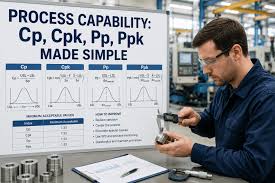
Today manufacturing is precision, consistency and continuous improvement. Customers will want products manufactured to a specific set of requirements the first time, every time, and no matter how many are produced, or where they are made. A slight difference in a critical dimension or material property can lead to increased costs, customer complaints, or production delays. Hence, manufacturers are increasingly turning to process capability testing instead of just product testing.
Leading manufacturers do not look for defects after the production process has finished but on the process itself. Process stability and minimization of process variation can lead to the production of high-quality products more consistently. This proactive strategy boosts efficiency and enhances the trust and adherence of the customers and regulatory bodies.
Understanding Process Capability Evaluation
Process capability is the ability of a manufacturing process to meet a set of specifications. It assesses if a process can produce products within a specified tolerance limits over time. A stable and predictable process means that waste can be kept to a minimum, productivity is improved and unnecessary rework is minimised, which saves time and money.
A Manufacturing process audit can be used to achieve this objective by looking at production methods, equipment performance, operator practices and process control. The audit does not focus on the finished product; it considers whether each stage of the manufacturing process is able to produce consistent quality products. This is important to learn about the weak points in the process before they become problems in the production.
Key Elements of Process Capability Assessment
The process capability assessment is based on technical analysis and operational observation. Performance data are captured by manufacturers and production activities on the factory floor are monitored as well. These activities make up a complete picture of the reliability of the process.
- Process Stability Analysis: Ensures production process is stable from one period of time to the next without any surprises.
- Equipment Performance Review: Ensures that equipment is performing within tolerances and is calibrated regularly.
- Capability Index Measurement: Involves measuring the process with the indicators of Cp and Cpk to gauge the process against the specification limits.
- Production Data Evaluation: Leverages past production information to find trends, common defects and points of improvement.
- Operator Compliance Review: Ensures standardized work instructions and operating procedures are consistently followed.
- Corrective Action Verification: Assures that any process problems that have been identified previously have been properly corrected.
Combined, the activities provide manufacturers with a much better overview of process health. Rather than simply responding to quality failures, they can limit their choices to informed decisions that will benefit the long-term performance of production.
The Importance of Statistical Process Monitoring
The use of statistical process monitoring enables manufacturers to monitor the performance of production processes on an ongoing basis, rather than performing occasional inspections. Control charts, trend analysis and variation studies are used to help engineers recognize abnormal conditions before any defective products are produced. This helps to minimize waste and enhance the efficiency of the production process.
The biggest benefit of statistical monitoring is that it is able to tell the difference between normal process variation and actual process failure. Manufacturers have little choice but to wait for data to show that some sort of corrective action is warranted instead of making unnecessary machine adjustments. This leads to better operational stability and enables to maintain product quality.
Common Challenges in Process Capability Improvement
It may not be easy to get a competent manufacturing process. Variation may be caused by part wear, raw material fluctuations, environmental changes and operator differences. No matter how automated a production line is, it needs to be monitored regularly to ensure that it performs as expected.
The other difficulty is the ability to gather accurate production information. Capability studies are less meaningful if measurements are inaccurate or there is inconsistent recording of data. To obtain reliable results from a process evaluation, the organizations need to invest in calibrated measuring equipment, standardized data collection procedures, and employee training.
Why Continuous Evaluation Creates Long-Term Success
Manufacturing continues to be an evolving field with automation, robotics and digital production technologies. The more complex the production system, the more valuable process capability evaluation is. Continuous monitoring allows manufacturers to keep their production consistent and work towards evolving customer needs and production requirements.
Companies that frequently assess their production methods also have the edge over the competition. Stable processes lead to better delivery performance, lower operating cost, better customer satisfaction and improve compliance to the international quality standards. As these enhancements continue to be implemented over time, they directly help with business growth and operational excellence.
Conclusion
The first step in obtaining consistent manufacturing quality is to know the performance of manufacturing processes. Combining the structured audits with statistical monitoring allows manufacturers to detect process variation early, increase operational stability, and establish better quality systems. This is proactive, and helps in lowering defects, boosting efficiency, and contributing to continuous improvement throughout the entire production process.
One of the key pillars of this strategy is Product Inspection, which serves as an additional layer of verification to ensure that the product is delivered to customers in accordance with the agreed quality standards. Process capability evaluation and final inspection can be combined to achieve greater reliability, customer confidence and sustainable operational performance for manufacturers.